Clinging thus to the outskirts of the great, sprawling, opulent city it seemed that at least there could not be any lack of food. Wang Lung and his family had come from a country where if men starve it is because there is no food, since the land cannot bear under a relentless heaven. Silver in the hand was worth little because it could buy nothing where nothing was.
Here in the city there was food everywhere. The cobbled streets of the fish market were lined with great baskets of big silver fish, caught in the night out of the teeming river; with tubs of small shining fish, dipped out of a net cast over a pool; with heaps of yellow crabs, squirming and nipping in peevish astonishment; with writhing eels for gourmands at the feasts. At the grain markets there were such baskets of grain that a man might step into them and sink and smother and none know it who did not see it; white rice and brown and dark yellow wheat and pale gold wheat, and yellow soybeans and red beans and green broad beans and canary-colored millet and grey sesame. And at the meat markets whole hogs hung by their necks, split open the length of their great bodies to show the red meat and the layers of goodly fat, the skin soft and thick and white. And duck shops hung row upon row, over their ceilings and in the doors, the brown baked ducks that had been turned slowly on a spit before coals and the white salted ducks and the strings of duck giblets, and so with the shops that sold geese and pheasant and every kind of fowl.
As for the vegetables, there was everything which the hand of a man could coax from the soil; glittering red radishes and white, hollow lotus root and taro, green cabbages and celery, curling bean sprouts and brown chestnuts and garnishes of fragrant cress. There was nothing which the appetite of man might desire that was not to be found upon the streets of the markets of that city. And going hither and thither were the vendors of sweets and fruits and nuts and of hot delicacies of sweet potatoes browned in sweet oils and little delicately spiced balls of pork wrapped in dough and steamed, and sugar cakes made from glutinous rice, and the children of the city ran out to the vendors of these things with their hands full of pennies and they bought and they ate until their skins glistened with sugars and oils.
Yes, one would say that in this city there could be none who starved.
Still, every morning a little after dawn Wang Lung and his family came out of their hut and with their bowls and chopsticks they made a small group in a long procession of people, each issuing from his hut, shivering in clothes too thin for the damp river fog, walking curved against the chill morning wind to the public kitchens, where for a penny a man may buy a bowl of thin rice gruel. And with all Wang Lung’s pulling and running before the ricksha and with all O-lan’s begging, they never could gain enough to cook rice daily in their own hut.
— Pearl S. Buck, The Good Earth
Everyone has at one point or another had the conversation about what they would do if they won the lottery. Whether the grand prize is $10 million or $50 million or $500 million or some number in the billions really is not the point of the exercise. It’s essentially the philosophical question from Office Space: If money wasn’t an object, and you didn’t have to work anymore, what would you do with your life?
Always I have been a pretty boring guy, and being pretty boring is not all that fun when it applies to fun philosophical questions such as these. Beyond all of the basic stuff — buying momma a house at the beach, breaking off my brothers and friends alike with some disgusting amount of cashola, putting in an order for a McLaren, etc. — I have never known what I would do. I have a strong feeling, however, that I would keep working. Because a worker is who I am and working is what I do.
It’s the mentality of a poor person, in other words. I simply can’t imagine a wave of contentedness falling over me if suddenly I had enough money to buy whatever house I wanted, wherever I wanted it, or whatever car I wanted, and essentially got to pick and choose which woman I wanted to be with, and how many children the two of us would have, and if I wanted to buy a jet I could do that, or if I wanted to buy a nice ass boat I could do that, too, or if I wanted to gamble there would be no bottom as to how much I was able to gamble or how frequently, or if I wanted to vacation to wherever, for however long, it would never be an issue.
I am a pretty boring guy, and this I know to be certain, but very little sounds as boring as the life I just described. Removed I would be from any challenges. No longer would I have to question anything at all. Life is a game that, at such a point, would be over — and I would be the winner. The only matters that would bring me any doubt would be the investments I made and, thus, the amount of money that would be left to my next of kin.
I have been talking recently to whomever will listen to me (which in this case is but a few of my best friends) about Maslow’s hierarchy of needs. It looks like this, just so we’re all moving along at the same rate:
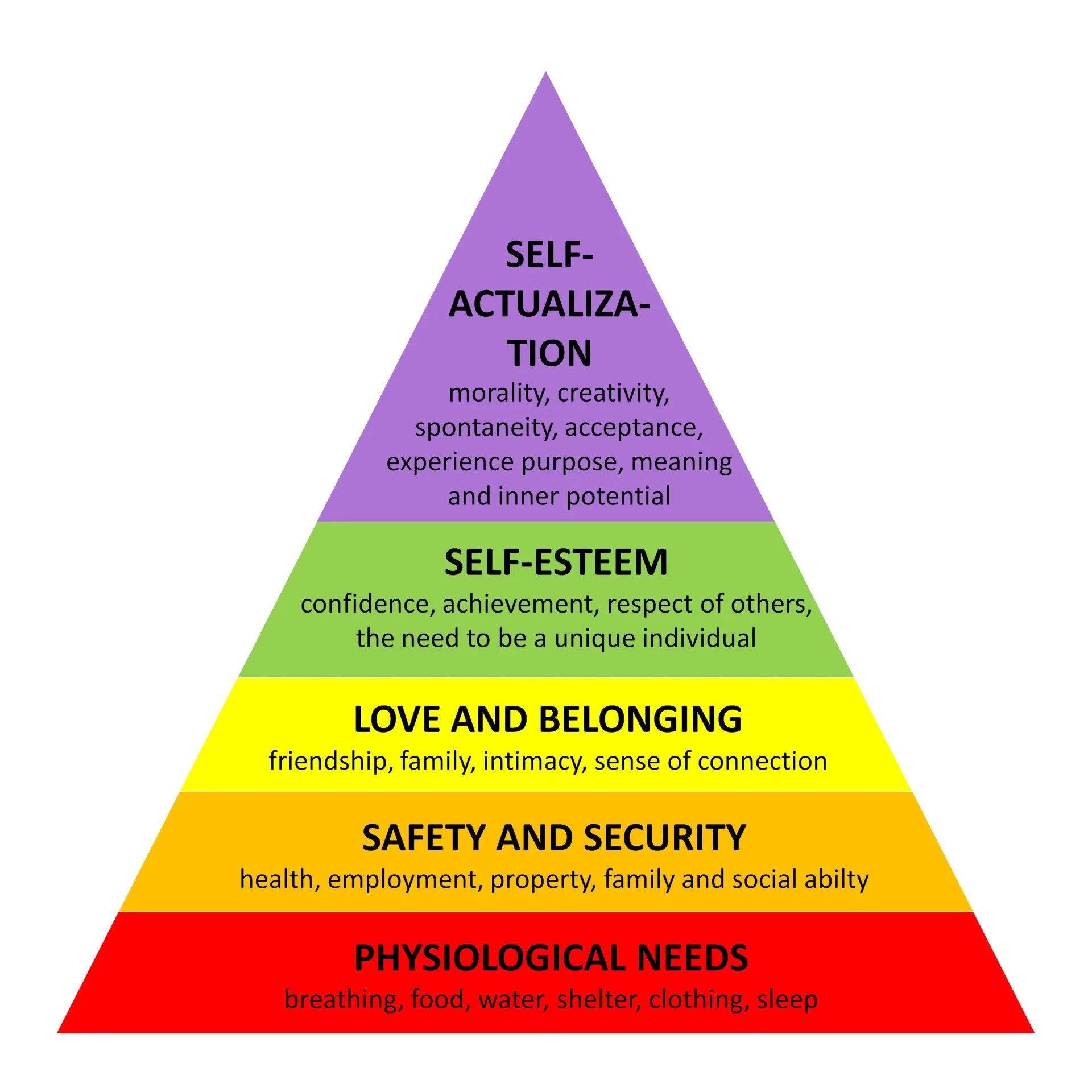
It probably looks like a corny explanation to why we act certain ways, or why we want certain things at certain times, but this very triangle — one that I didn’t learn about until I went to my first offender DUI program c. 2015 — accounts for quite a bit, I argue. For almost my entire life I have been blessed enough not to have worried about food, or shelter, or being loved, or having an inflated impression of my own self-worth, which is why I have had the privilege of bullshitting on places such as here, or in common conversation during everyday life, about philosophy — which manifests itself through discussing religion and politics and day-to-day strategy and what exactly I intend to do with my disposable income.
Through it all, somehow, I have never seemed to find the elusive concept I so often seek called happiness. This is how I know that no amount of money will ever make me feel more fulfilled. If anything, the challenge of existence and the struggle of not knowing if I am ever enough, or that I do not possess enough, materially, is what really gets me going. It’s all I have ever known that generates for me actual excitement.
It may be to my detriment that I never learned any hobbies that I truly love. I can’t have it all and fuck the rest of my life off going to the beach, or the river, riding a jetski. Even though I enjoy nature and I love hiking, I wouldn’t spend any meaningful amount of time seeking out scenic destinations and exploring them. I don’t know how to build anything. And while I do love sports — which is what I am most passionate about — I’ve always felt it a drag to actually attend sporting events and be around other people when I would much prefer to watch it on television. Am I the lamest person who has ever existed? People have been wondering.
I don’t even know where I was going with that. I think I went into this article with the intention of relating — and rather easily, because it’s so obvious — the excerpt from The Good Earth to modern day America. You know, the country of such abundance but where seemingly everyone is poor in one way or another. I’m sure a part of me also had a mind of taking the approach of John Lennon’s Working Class Hero and arguing, per Maslow’s hierarchy, that there is nothing wrong with a simple life.
But then again I haven’t been able to write in like a whole ass week because I came down with strep throat. Whatever intention and verve sprung out of my loins last weekend somewhere became lost in the pools of sweat that absorbed into my bedding, or all the times I came down with the chills, or in the moments I dozed in and out of consciousness and slipped away from any concept of time. The sore throat was the worst of it. I can’t ever recall being sicker for such a prolonged period than I was up until about twelve hours ago.
I don’t normally mind being sick, because (a) I don’t get sick hardly at all, maybe every year or so, and (b) when I do it’s typically a common cold where my sinuses pour out and I’ll sneeze a bunch and have a runny nose for a handful of days. It is nothing. I throw on a mask and go to work and, yeah, it’s annoying and everything but it doesn’t keep me from living more or less exactly as I would have otherwise.
It’s hard to even call that ‘being sick,’ when you compare it to literally not having the ability to swallow your own saliva without feeling some urge to grunt or groan or, after the hundredth- or two-hundredth time, fight back tears because it just hurts so goddam bad. Where the doctor tells you to drink lots of liquids even though transferring anything from tongue to throat to esophagus is entirely the last thing you want to do. When your stomach screams relentlessly at you for food. You can’t function, so all you wanna do is sleep.
Another thing is it was just bad timing. After vacationing the last week of June and into the first week of July, and then missing a week towards the end of July, it just feels like I have missed out on a helluva lot of work. I don’t know how much money I have missed out on, and I don’t know how much money I will need to make up in the coming days and weeks. I just know from here on I am pretty much on a straight shot through the new year (and likely then some) where I will not be missing any days. It’s neither daunting nor is it much of a challenge to think about; it’s simply an objective fact that I have missed more time in terms of work days (9) over the last calendar month that I have missed in, at minimum, my two years prior.
Which, I suppose, could probably be considered something of a blessing. A blessing that I didn’t require the mental break that induced me to take a vacation in the first place. A blessing that I didn’t require the physical break that came from a sickness as severe as strep throat. These items don’t often occur, but when they do it seems to fall in the department of It Gives A Man No Choice. So I will let it lie right there.
Alas, in spite of the incomparable pain that this particular iteration of strep throat presented itself as to me and my body, the kind of brilliant thing with being so utterly fucking sick is a weird sense of clarity. I can be a pretty dramatic guy, so it doesn’t take much from me to jump from square one — where I am alive and well — to square two — where I am quite sickly — to convince myself that, actually, everyone has to die, and maybe it’s my time. Maybe the death strain of Covid, or whatever horribly obscure combination of sicknesses that have all had their babies, finally arrived at me, and maybe my sore throat was just never going to get better and my body would want to do nothing but sleep and that my blood would go septic and then everything would just shut down on me and the lights wouldn’t come back on.
This is where my brain has to take matters to make myself feel happy and fortunate to be alive. For an instant, even if only a week, I didn’t have to ponder my place in the world, or my relationship struggles, or how soon it is I plan on attending law school, or buying a house, or if I will ever marry or have children, if I will ever be able to present my parents a grandchild while they are alive, if I am actually capitalizing on all of my gifts or if I am selling myself short entirely. I didn’t have to imagine or contemplate any of those things. For an entire week all I had to care about was when my sore throat would finally dissipate. It was the worst of times. But I can appreciate it now that I am on the other side.
One could say I was back on the bottom rung of Maslow’s hierarchy. I assume that’s where Wang Lung found himself before he scored on all of his gold and riches, those that ultimately impressed upon him so much misery in the second act of The Good Earth. Now that I climb, up, and up some more, upward on the dreaded hierarchy, I must confront once again the correlation between the apex of the pyramid and the distance that creates from my own peace of mind.


Leave a Reply